
Interview
Can sensor‑based sorting make pebble recirculation more selective?
TOMRA Mining's Fernando Romero‑Lage explains how sensor‑based sorting can reduce low‑value pebble recirculation and improve overall grinding circuit efficiency. Alejandro Gonzalez reports.

Main image: Fernando Romero-Lage. Credit: TOMRA Mining
P ebbles are a routine part of hard-ore grinding circuits, but treating the stream as uniform can send low-value material back through the mill unnecessarily. Recent test-work suggests that the value of individual pebbles can vary considerably, raising questions about whether all of the material needs to be crushed and recirculated.
That raises a practical question for operators: if some pebbles contain little economic value, does every particle need to be crushed and returned to the grinding circuit? Sensor-based sorting offers a way to assess individual particles before deciding which material should continue downstream.
In this Q&A, Fernando Romero-Lage, area sales manager at TOMRA Mining, discusses the use of X-ray transmission (XRT), near-infrared (NIR), laser, colour and electromagnetic (EM) sorting technologies, as well as the skills required to operate them. He also considers how selective pebble rejection could change the design and operation of crushing and grinding circuits.
Alejandro Gonzalez: Pebble streams can contain a much wider variation in mineral value than operators have traditionally assumed. From a technical perspective, what evidence is now challenging the long‑standing view that all pebbles should simply be recirculated through the grinding circuit?
Fernando Romero-Lage: First, we need to define the characteristics of pebbles. In most cases, pebbles are highly heterogeneous at the particle level and can range from barren to significantly above feed grade. Studies have shown little direct relationship between pebble size and metal value. That means screening alone does not separate value, but particle-by-particle sensing can. Based on recent test-work reviewed by SRK and TOMRA, up to 80% of the contained metal was found in roughly half of the particle mass, leaving the remaining fraction largely below cut-off grade.
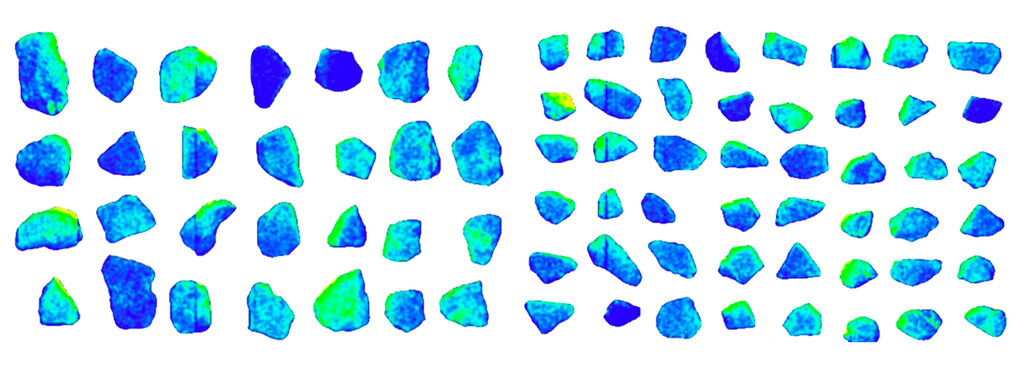
XRT image scans of pebbles from a semi-autogenous grinding mill, showing coarse material (left) and fine material (right). Credit: SRK Consulting
Technically, this changes the question from “how do we crush and recycle all pebbles?” to “which pebbles are worth sending back to the mill?” XRT and other sensors now allow operators to remove low-value pebbles before they consume mill volume, energy and crusher capacity, while retaining the higher-value fraction for recovery. Reported case results include 4–6% throughput improvements, reduced pebble crusher load, and recovery of more than 90% of contained metal while rejecting around 25% of pebble mass in one copper example.
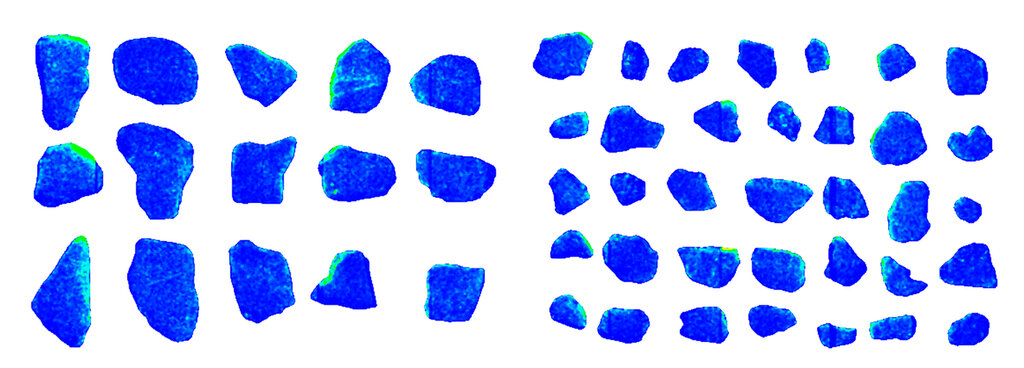
XRT image scans of pebbles from an autogenous grinding mill, showing coarse material (left) and fine material (right). Credit: SRK Consulting
Alejandro Gonzalez: XRT is widely used in mining. How quickly can your X-ray transmission systems analyse and classify individual rocks on a live conveyor, and what are the practical size limitations for effective deployment? At what point does a pebble become too large to penetrate?
Fernando Romero-Lage: TOMRA’s XRT systems scan individual particles in milliseconds as they pass on a conveyor. The sensor produces an X-ray attenuation image of each rock, the software classifies it, and high-speed air jets physically separate accepted and rejected material.
For particle size, the practical range depends on the machine and application. TOMRA’s COM Tertiary XRT is specified for 6–60mm material at up to 150 tonnes per hour (t/h), making it well suited to smaller pebble and tertiary crushed fractions. The larger COM XRT 2.0 is specified for 10–125mm material, with feed rates up to 250t/h.
A pebble becomes “too large” for XRT when the X-rays can no longer penetrate the rock with enough contrast to distinguish mineralised from barren material. That is not a universal diameter; it depends on density, atomic composition, thickness and X-ray power. As a practical mining guideline, 125mm is a common upper XRT design boundary for high-throughput applications. Above that, penetration and classification reliability become increasingly ore-specific, especially for dense or high-atomic-number material.
Alejandro Gonzalez: Accuracy is central to the economics of sensor‑based sorting. How precise are current XRT systems in distinguishing economically valuable pebbles from low‑grade or barren material, and what factors most affect that accuracy in real mining environments?
Fernando Romero-Lage: There is not a universal accuracy number for XRT because sorting accuracy is deposit-specific. A more useful measure is how much low-value material can be rejected while retaining the economic metal. In pebble applications, the reported economic target is often to reject a meaningful mass fraction while retaining more than 90% of contained value, as documented in a copper example where about 25% of pebble mass was removed while over 90% of metal was retained.
Accuracy is strongest when there is a clear particle-scale contrast between ore and waste: density contrast, atomic-density contrast, sulphide inclusion contrast, or a consistent association between valuable minerals and XRT-detectable phases. XRT is less sensitive than optical technologies to surface moisture, dust or dirt because it reads internal attenuation rather than only surface appearance.
The main real-world factors affecting accuracy are feed preparation, size ratio, particle presentation, mineral liberation, ore variability, sensor calibration, belt loading, ejection timing and air pressure. The feed must be screened into a controlled size fraction; TOMRA’s COM XRT specifications use a 1:3 size ratio, which reflects the importance of presenting particles in a manageable size band. Software is also becoming more important, particularly for complex ores where traditional density thresholds alone are not sufficient to distinguish valuable material from waste.
Alejandro Gonzalez: NIR sorting is increasingly associated with lithium applications. How is NIR being used in lithium ore sorting today, and where does it offer advantages, or limitations, compared with XRT systems?
Fernando Romero-Lage: NIR is used where lithium-bearing minerals or associated gangue minerals show distinguishable near-infrared spectral responses on the particle surface. In practical terms, NIR can help differentiate minerals that look similar to the eye or to standard RGB cameras.
NIR is one of several sorting technologies that can be used in lithium processing, alongside XRT, colour and laser. Its advantage is mineralogical discrimination where surface spectral differences exist. Its limitation is that it is fundamentally a surface-reflection technology: if the target mineral is not exposed, or if the surface is coated with dust, clay, weathering or fines, the reading can be compromised. XRT, by contrast, reads internal density/atomic-density differences and is more robust to surface contamination, but it can struggle where lithium-rich and barren rocks have similar density. At Pilgangoora in Western Australia (WA), barren host materials can have densities similar to lithium-rich spodumene, complicating separation; the plant therefore uses a combination of XRT and colour sorters across different size fractions rather than relying on one sensor type.
NIR is valuable when the lithium mineralogy or alteration halo is spectrally visible at the rock surface; XRT is preferred when the ore/waste contrast is internal density or atomic density-based; and many lithium applications benefit from multi-sensor flowsheets rather than a single universal technology.
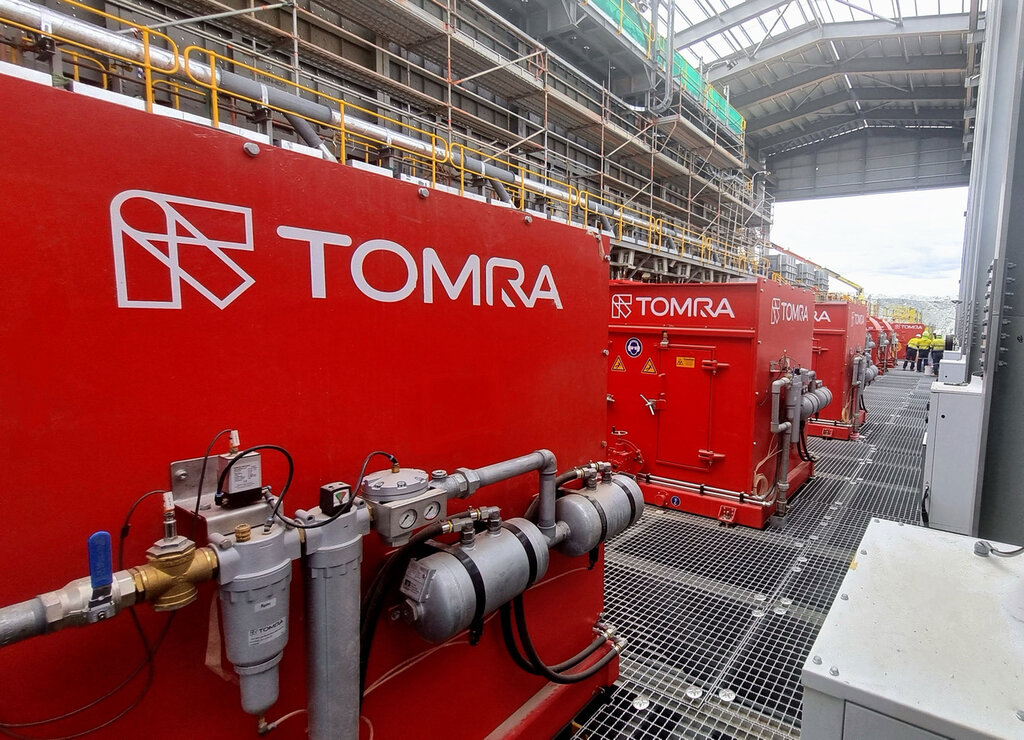
TOMRA XRT sorting equipment at the Pilgangoora lithium operation in WA. Credit: TOMRA Mining
Alejandro Gonzalez: TOMRA also deploys technologies including laser-induced systems, RGB optical sorting and EM sensors. In practical terms, has XRT effectively superseded them for most mining applications or do they continue to serve distinct mineralogical niches?
Fernando Romero-Lage: XRT is widely used because it can assess internal particle properties rather than relying only on surface appearance – but it has not made the other sensors obsolete. They still serve distinct mineralogical niches.
Laser remains highly relevant where texture, reflectance, fluorescence or surface scattering is more diagnostic than density. It is especially strong in industrial minerals such as carbonates, quartz, rock salt, fluorspar and some lithium applications. In high-purity quartz, for example, multi-channel laser sorting can distinguish materials that colour, XRT and NIR may not separate effectively. At the Mt Cattlin lithium mine in WA, TOMRA’s PRO Secondary Laser sorter has been used to reduce basalt contamination in spodumene ore, consistently achieving below 4% basalt in the sorter product.
RGB/colour sorting remains preferred where visible colour is the economic discriminator: burnt lime, calcite, feldspar, magnesite, quartz, talc, and certain industrial-mineral quality applications. NIR remains relevant for minerals with diagnostic spectral signatures such as talc, borate, calcite, lithium and kimberlite. EM sensors are still important where conductivity or magnetic/permeability properties matter, such as slags, ferrochrome, ferrosilicon, massive nickel sulphides and manganese.
In simple terms, XRT is widely used for mining pre-concentration, but sensor selection is mineralogy-driven. Laser, RGB, NIR and EM continue to be preferred when the ore/waste contrast is optical, spectral, textural or electromagnetic rather than density-based.
Alejandro Gonzalez: Sensor-based sorting is often presented as an automated process, but the underlying systems appear highly sophisticated. What kind of workforce and technical expertise is required to operate, calibrate and maintain these installations, and are mining companies facing a skills gap as adoption expands?
Fernando Romero-Lage: Sensor-based sorting is automated, but it is not a “black box” that eliminates technical expertise. A successful installation needs operators, maintenance and instrumentation/control support and staff who understand the data and how the sorting decision affects the mass balance and downstream plant.
Operators need to understand alarms, belt loading, cleaning requirements, feed presentation, HMI [human-machine interface] operation and splitter settings. Maintenance teams need mechanical, electrical, pneumatic and instrumentation competence, especially around belts, calibration equipment, compressed air, feeders, sensor cleanliness, valves and X-ray safety systems. Metallurgists and process engineers need to interpret grade-recovery curves, adjust thresholds and integrate the sorter with crushing, screening, grinding and stockpiling strategy.
The skills gap is not usually basic operation; modern machines are designed to be user-friendly. The larger gap is actually application expertise: knowing how to test the ore, select the right sensor, set the correct size fraction, calibrate thresholds and understand the economic trade-off between mass rejection and metal recovery. TOMRA’s test centres emphasise that sorting is not one-size-fits-all and must be validated under site-specific operating conditions.

In early June 2019, mining companies avoided increases to royalties by agreeing to provide A$70m to a A$100m infrastructure fund.
Frank Smith, Founder and CEO of TowHaul
THAAAAAAAA
Alejandro Gonzalez: Much of the discussion around sorting technologies focuses on the hardware itself, but the broader argument seems to be about circuit optimisation rather than simply deploying sensors. When considering “processing what adds value”, how fundamentally does that change the way mining companies should think about crushing, grinding and plant design over the next decade?
Fernando Romero-Lage: That is a great point. Sensor sorting is not simply about adding a machine; it changes the approach to the circuit. Traditional plants are designed around processing all material that reaches the mill at the maximum reduction possible. The new approach asks whether each coarse particle deserves to consume crushing, grinding, water, reagents, power, residence time and tailings capacity.
In pebble circuits, this means the recirculating load becomes a managed value stream, not an unavoidable burden. Low-value pebbles can be rejected before they displace fresh feed, while high-value pebbles continue through to grinding. In ROM [run-of-mine] or crushed-ore applications, it means crushing and screening are no longer just size-reduction steps; they become preparation stages for value-based separation.
Over the next decade, this should push companies to design plants with more flexible crushing-screening-sorting integration: controlled size fractions, surge capacity, bypass options, separate ore/waste handling, and downstream circuits sized for upgraded feed rather than raw feed. It also affects tailings and waste strategy. Early rejection reduces energy consumption, water use and fine tailings generation, while coarse rejected material may be usable as aggregate or infrastructure material when chemically clean.
So the fundamental change is this: comminution should no longer be treated as the automatic destination for every tonne. The future plant will be designed to identify value early, reject cost early and reserve grinding energy for material that can actually pay for it.
