Feature
Yimin coal mine: what 100 AI-driven electric trucks taught the mining sector
At Inner Mongolia’s Yimin mine, 100 AI-driven electric haul trucks operate in extreme conditions. The project showcases advances in autonomy and connectivity and raises questions about coal’s long-term future. Eve Thomas reports.
Main image: May 2025 saw the deployment of 100 electric, AI-driven trucks at the Yimin coal mine in Inner Mongolia. Credit: Huawei
Ten months ago, the mining industry felt what may prove to be more than a symbolic tremor. At the Yimin coal mine in Inner Mongolia, a 100-strong fleet of electric, 5G-Advanced (5G-A) connected, AI-driven autonomous trucks were deployed in temperatures of -48.5°C.
The deployment is framed as a breakthrough in safety and productivity – but is also raises a harder question: does electrified autonomy decarbonise mining or entrench coal’s commercial life?
Developed and manufactured by China Huaneng, Xuzhou Construction Machinery Group, Huawei and State Grid Smart Internet of Vehicles, the Huaneng Ruichi fleet is designed specifically for Yimin’s extreme conditions.
The open-pit mine experiences prolonged sub-zero conditions, dense dust and fog, and an average annual precipitation of 354.73mm, half of it concentrated in July and August.
The mine reportedly holds proven reserves of more than 725 billion tonnes (bt). There is no shortage of difficult terrain ahead and no shortage of pressure to improve safety and efficiency.
Electrification, autonomy and connectivity form the technological core of the project. The trucks combine onboard AI with 5G-A connectivity to position electrification not simply as an environmental, social and governance exercise but as an operational strategy.
Li Shuxue, chairman of Huaneng Inner Mongolia Eastern Energy, said: “The Huaneng Ruichi trucks have set three new records for autonomous electric mining trucks: the world's largest payload, fastest running speed and lowest operating temperature.”
Electrifying in the extreme: battery innovation
At its warmest, Yimin reaches a bitter -36.8°C. In electric vehicles (EVs), cold typically reduces range, slows charging and affects performance.
Each Huaneng Ruichi truck runs on a 568kW-hour (kWh) lithium iron phosphate battery. Battery-powered haulage remains an emerging technology, concentrated in China; as of March 2025, GlobaData was tracking 387 battery-powered trucks operating on surface mines worldwide, 72% (278) of them in China.
At Yimin mine, the batteries replace the traditional truck cab configuration and deliver around five-times the capacity of a typical passenger EV battery. Despite the scale, the trucks reportedly consume approximately 0.2kWh/km per cubic metre, regardless of temperature – around the same as a passenger car.
To reduce downtime, Huaneng installed automated battery-swapping stations rather than relying on fixed charging. Swaps take around five minutes and are fully automated.
State Grid Smart Internet of Vehicles begin developing this battery-swapping system in 2019, alongside Huaneng Inner Mongolia Eastern Energy.
Senior adviser Tang Wensheng said: “After four years of joint effort since then, we developed a fully autonomous battery-swapping and station monitoring system for pure electric mining trucks. Up to 100 autonomous mining trucks can automatically have their batteries swapped, with each swap taking just 5-odd minutes, at an operational success rate of over 98%.”
Heavy fog and frequent dust storms also present severe visibility and mobility challenges at Yimin. Haulage-truck incidents have previously been identified as the most common cause of fatal accidents in the mining industry.
Adverse weather makes trucks more likely to fail, a point previously made by Dirk Claessens, IBM managing director for Shell’s Royal Dutch account: “We did a study of the coal-mining industry in China, where 3,000 people are killed every year, and 80% of these deaths were caused by equipment failure.”
The project’s logic is explicit: remove drivers from hazardous environments. Zhang Ping’an, executive director of Huawei and CEO of Huawei's Cloud Computing BU, explained: “It is a paramount challenge to safeguard personnel and equipment safety while improving productivity in extreme working conditions such as freezing temperatures at high altitudes, and heavy rain, snow and dust. Addressing such challenges places high requirements on data processing and system collaboration capabilities.”
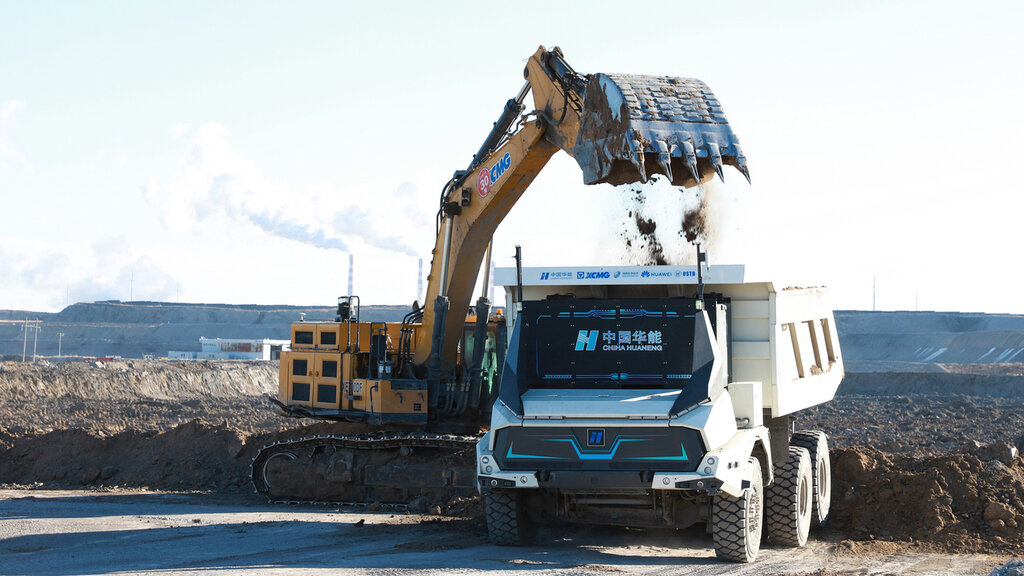
By 2024, the autonomous trucks were achieving 120% of human productivity. Credit: Huawei
The associated digital infrastructure
The AI and connectivity capabilities of the Huaneng Ruichi fleet are the cornerstone of the deployment. The Yimin mine is the second-biggest open-pit coal mine in China (the world’s largest coal producer) and was estimated to cover around 177.35km² in 2020, with the site likely to be larger now.
The AI stack relies on Huawei’s 5G-A network, developed with China Mobile Inner Mongolia. Also known as 5.5G, 5G-A enables ultra-low latency communication, critical for real-time vehicle control in obstacle dense open pits.
The site used to require around 300 trucks, operated by 1,200 drivers, to run 24/7 but a notable recent shift in driver safety has been instrumental in spearheading change. In a briefing released last week, GlobalData analyst Sai Dheeraj Karanam notes: “Growth momentum slowed in the second half [of 2025] as intensified safety inspections and regulatory oversight constrained output across key producing regions […] Inner Mongolia ordered the suspension of 15 mines, while Shanxi cut production by 7% as 54 mines with annual capacity of 61.1 million tonnes (mt) were halted or scaled back due to safety-related constraints.”
It also integrates AI and machine learning at network level, enhancing performance and supporting AI-driven applications such as the Huaneng Ruichi trucks.
5G-A also offers advanced positioning services, providing high-precision location data, as well as network slicing, which supports network virtualisation and enables flexible positioning of physical 5G infrastructure, essential in challenging and remote environments.
To connect the 100-strong autonomous electric truck fleet across driving routes, mining areas, dumping areas and battery exchange zones over almost 200km at the Yimin mine, China Mobile Inner Mongolia harnessed Three-Component Carrier (3CC) technology. Base stations across the site were upgraded, to cover between 500 and 600m, offering 500 megabits-per-second uplink speeds with 20-millisecond latency. The rapid uplink speeds enable 8K video transmission in real-time, while low latency helps the trucks to operate 24/7.
To provide real-time reactionary solutions, Huawei also developed its Cloud Commercial Vehicle Autonomous Driving Cloud Service (CVADCS), in collaboration with its automotive partners. Each truck has five cameras that work alongside radio detection and ranging systems to provide 360° vision and stable perception up to 40m away. The system works in low-light conditions such as snow, sandstorms and during the night, and feeds inputs to the AI piloting the trucks.
Paired with integrated data analytic capabilities, visual inputs enable the CVADCS system to automatically navigate the dynamic open-pit mining environment, unperturbed by falling rocks or retaining walls. When obstacles are too significant, the system enables the Huaneng trucks to perform single-manoeuvre U-turns in narrow spaces.
Deputy general manager of Huaneng Yimin Coal and Electricity and director of Yimin open-pit mine Shu Yingqiu explained: “We have also developed a dispatching system for them based on vehicle-cloud-network synergy and 5G-A networks. The system enables the trucks to collect map information in seconds and update their map in minutes.
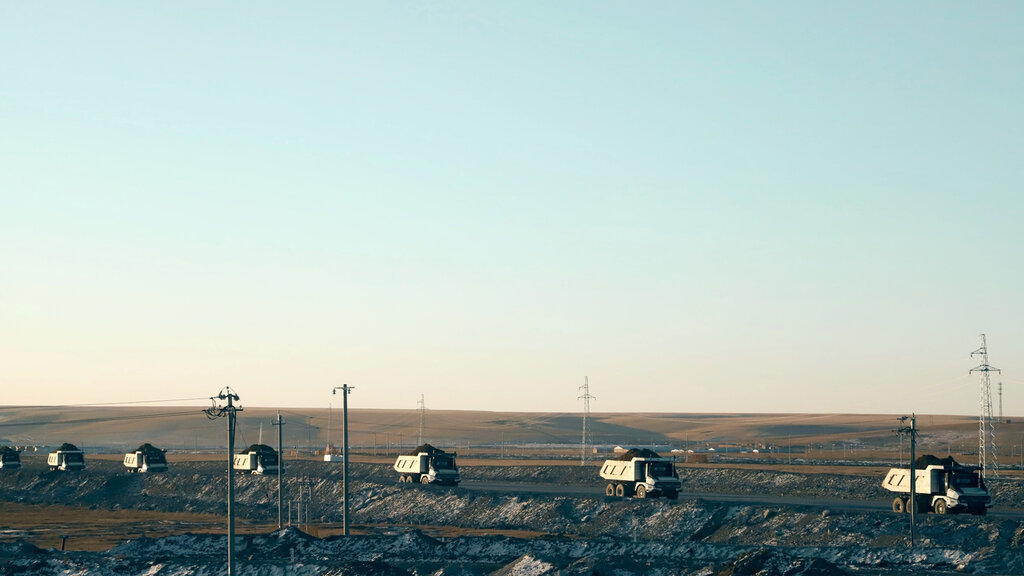
The Yimin coal mine was estimated to cover around 177.35km2 in 2020. Credit: Huawei
“Furthermore, the innovative multi-lane switching solution allows the simultaneous implementation of autonomous driving and other tasks such as road repair and maintenance. Huaneng Ruichi trucks have no driver cabins, and do not require any manual operation, which makes open-pit mining and transportation significantly safer.”
For the wettest, muddiest conditions, the trucks also support a vehicle anti-sinking and recovery control system, providing an additional safety net for the heavy haulage trucks.
How to reach unmanned, large-scale deployment
Despite the global push to move away from coal, there is still a drive for safety and efficiency, which has translated into its own market. Huawei reports that China accounts for more than 45% of the global intelligent coal mining market, noting that intelligent coal mines in Inner Mongolia specifically represent a total production capacity of 1.02bt – 44% of China's total intelligent coal mine production capacity.
Realistic, scalable solutions are therefore a lucrative space, and the industry has watched the electrification and automation of trucks at the Yimin mine closely; successful deployment has ramifications for a sector that needs both efficiency and accessible decarbonisation strategies.
The implementation at Yimin was gradual. Initial trials began in April 2020 with the ‘autonomous dynamic commissioning phase’, five years before the ultimate deployment in May 2025. These trials used retrofitted diesel trucks with a payload capacity of 172t.
By 2024, the autonomous trucks were achieving 120% of human productivity. In the same year, nine all-electric trucks were deployed ahead of the 100-strong fleet; these nine trucks are now purported to have moved more than 1.3 million cubic metres of earth.
The electrification trend is doubtless here to stay, and early implementers are being carefully watched by the wider industry. However, most innovation is still in the trolley-assist space, with roll-out primarily occurring across African mines (Zambia leads with 132 trolley-assist trucks, followed by Namibia with 56 and South Africa with 20); however, Chinese original equipment manufacturers are driving progress in the battery-powered truck space.
According to Huawei, by the end of 2024, 344 autonomous mining trucks were in regular operation across 43 open-pit coal mines, offering a cumulative haulage distance of more than 500,000km. The sector is developing, and China has positioned itself at the forefront of the new market.
An open question
The Yimin delployment demonstrates that electric autonomy can function at scale in extreme cold. It appears to reduce human exposure to hazardous conditions and it may lift productivity beyond known benchmarks.
Yet the broader implications remain unsettled. Electrification reduces on-site diesel consumption, but the mine still extracts coal.
The question remains: if AI and digital infrastructure make coal extraction safer and more economical, does that accelerate decarbonisation or delay it?
As the Yimin fleet experience so far suggests, unmanned, battery-powered open-pit mining is technically viable, but whether that capability ultimately reduces emissions, or reinforces the commercial durability of coal, is a question for mine operators that extends beyond Inner Mongolia.
