Company Insight
Sponsored by Wabtec
Wabtec’s AI smart cameras give mining operators a new edge
Standfirst...
Main image credit:
Mining and construction sites are chaotic, dynamic, and full of blind spots. Wabtec believes AI Smart Cameras can close that gap by giving machines and operators a clearer picture of what’s happening around them.

Mitch Tanzer, Global Commercial Director, Wabtec
We sat down with Mitch Tanzer, the Global Commercial Director at Wabtec, to unpack how their newly expanded camera range is making proximity detection simpler, faster to deploy, and better suited to the detailed realities of mining, quarrying, and construction.
Can you explain how AI smart cameras are transforming real-time decision-making for mining operators?
AI Smart Camera’s bring another ‘sense’ to the table for mining operators. At Wabtec, we have well developed advanced sensor technology but with AI Smart Cameras, we give operators the ability to physically see and perceive their surroundings in real-time. That means, good active decision-making for operators.
AI Smart Cameras are a compelling solution for companies to soft-enter and scale within the proximity detection arena. Not every vehicle scenario needs a complex solution deployed to their entire fleet.
Wabtec has recently expanded their portfolio to include a new smart camera range, and I’ve heard you’re looking to deploy the technology out into other industries too?
Yes, our smart cameras are already working within other industries, such as civil construction, quarrying and ports where there are autonomous machines moving in tight, confined spaces. Warehousing is another environment that can have GNSS-denied areas with confined spaces. You have small, fast-moving machines operating around people, it’s a very dynamic environment. That’s where AI Smart Camera technology thrives.
Can you explain the installation process of an AI Smart Camera system? Is it long and complexed or is it as simple as plug & play. What’s involved?
I think about installations in two ways. There’s the physical installation that’s designed to be simple, quick and easy. Positioning the camera is vital to maximise the field of view, it’s then a matter of configuring the system.
The other side is the simplicity of deployment. The value add commences the moment that machine goes back into operation. You see the benefits immediately.
AI Smart Cameras link straight to a Wi-Fi network or cellular network. This is where the system provides back-to-base reporting and generates over-the-air software or configuration updates. From that point the system is stand alone, not requiring Wi-Fi or cellular connections to operate. The power source comes straight from the truck or asset.
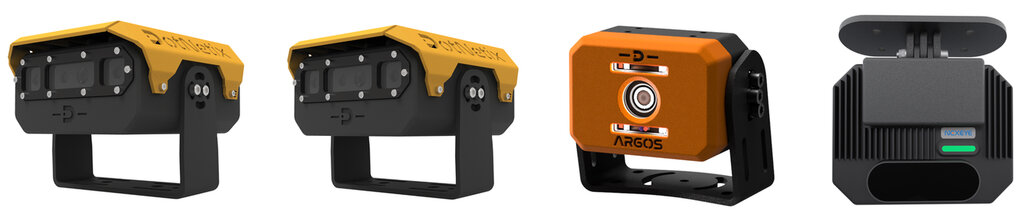
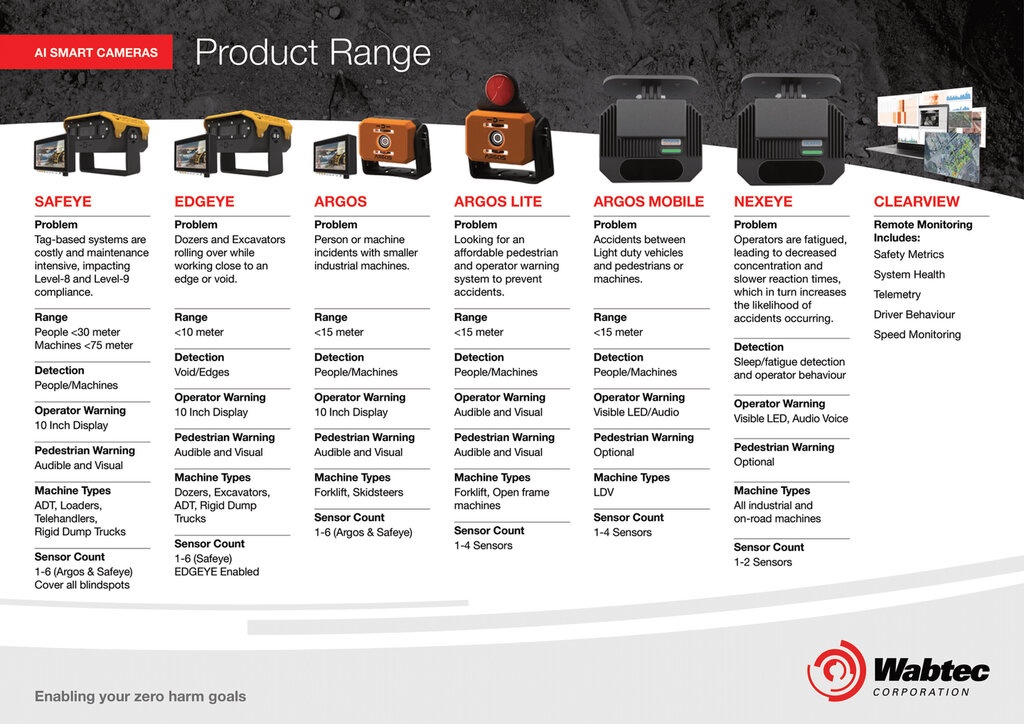
SAFEYE adds versatile stereoscopic detection, identifying people and machines across busy worksites for an easy, low-barrier entry into proximity awareness. EDGEYE uses stereoscopic vision to help dozers and excavators detect edges and voids. ARGOS brings people-and-machine detection to smaller industrial fleets like forklifts and skid steers. NEXEYE monitors fatigue and operator behaviour in real time.
Mining, quarrying and construction have been tough nuts to crack for smart cameras and sensing. Why do you think that is?
It's important we put ego aside and acknowledge that while we understand surfacing mining, we can’t simply take those experiences into quarrying, civil construction etc.
The competitive advantage we have at Wabtec is the ability to understand the problem. A civil construction problem is going to be vastly different to quarrying or ports. Once we have a clear understanding of the problem that needs to be solved, we design and customise a suitable solution. It’s our fundamental approach: problem first, architecture second and ultimately the result comes third.
Could you provide a couple of examples where different cameras in your portfolio apply their strengths to their industry, or their area of operation?
Some AI Smart Cameras are designed to be more robust with varying capabilities in range, whilst others have more perception, such as NEXEYE for fatigue detection. As an example, ARGOS is a smaller camera that’s economical and designed for smaller scale applications such as forklifts and skid steers or bobcats. Again, we define the problem then curate the solution. For a small forklift in a warehouse, a SAFEYE stereoscopic camera with a detection range of 75 meters is overkill. Whereas ARGOS, being a smaller camera, slightly wider view and lower detection range, is perfect for a warehouse.
A sore point of mine has been the lack of a fatigue detection solution in our portfolio, but that’s changed now. In NEXEYE, we have a fatigue detection camera that is highly capable and fit for purpose. It’s a compact design, quick and easy to install and has a low total cost of ownership. It’s that kind of simplicity our customers tell us they really like.
Caption:
In August 2023, Resources Safety and Health Queensland reported 19 dozer rollovers in an 18-month period. That's one per month. That's a significant risk for any mining company. How could your AI smart camera system help solve that problem?
The beauty of stereoscopic 3D vision is its depth of perception. If we go back to the problem statement; what we’ve observed in the mining industry is a lot of dozers operating in perilous conditions, it’s what they need to do. As a workhorse, they’re constantly pushing material towards an edge. If you’ve seen a large dozer with a large blade, you’ll notice their view is constantly being obscured. The problem we needed to solve was how to empower operators to safely work in these environments whilst providing context and situational awareness. So, for that problem, EDGEYE is a fantastic solution. It enables operators to see edges and voids whilst receiving alerts on roll angles, differentiating between what is safe and unsafe.
The applicability is not just for manned dozers but also unmanned dozers.
Are there any hidden costs or savings that companies often overlook with these types of systems?
Quality Change Management programs are critical to the success of any technology project, especially the deployment of AI Smart Cameras. It’s no surprise that the sites that excel with their adoption of technology, and see a faster ROI through productivity increases, are the sites that give Change Management the funding it deserves. It shouldn’t be viewed as a hidden cost but rather an investment in success.
In industries such as mining, where skilled labour is hard to find and conditions are demanding, employee retention is a genuine saving in more ways than one. Every experienced operator who stays at their job, because they feel safe, is a saving. It’s also a preservation of expertise, a saving that is hard to define but easy to lose if we, as decision makers, don’t continue to put people first.
Does Wabtec do any demonstrations of its camera equipment? Or, where can people see them in action?
As part of our commitment to deploying AI Smart Camera technology more broadly, our plan is to have demonstration systems available at our offices globally. We already have demonstration circuits available at our Fountaindale Office which have been popular with potential customers. It’s a great opportunity for people to come in, see, touch, feel the equipment and ask questions.
Ultimately, the most important thing is to invite people in, take a seat at the table and talk about the problem that needs to be solved. Let’s work through some of the complexities of your operation, your challenges, your constraints and then you can walk away with a better understanding of how Wabtec can support you and your operation, in a real and tangible way.
Contact information
Wabtec Digital Mine
Eagle Farm
Brisbane, Australia
Tel.: +61 7 3177 4226
Email: apac.dmt@wabtec.com
Web: www.wabteccorp.com