Company Insight
Sponsored by Fourthane
Keep your operations running strong and steady: the world's benchmark for conveyor belt repair, built in Chilean mining
For nearly 30 years, one product has defined the standard for conveyor belt repair in global mining. The Fourthane Red Line family — born in Chilean mining, proven across five continents — leads the world in elongation at break, abrasion resistance, and impact performance. And it keeps getting stronger.
Main image credit:
For nearly 30 years, one product has defined the standard for conveyor belt repair in global mining. The Fourthane Red Line family — born in Chilean mining, proven across five continents — leads the world in elongation at break, abrasion resistance, and impact performance. And it keeps getting stronger.
A conveyor belt failure doesn't announce itself. One moment the operation is running at full throughput; the next, production is stopped, maintenance teams are scrambling, and every hour without a fix becomes a cost the operation will feel. It was precisely this reality that drove Fourthane, in its earliest days, to answer a question the industry had left open: what if you could repair the belt right there, right then — without removing it, without calling a contractor, and without shutting down the mine?
The answer was Fourthane Red Line Classic, and it changed the way mining operations around the world approach conveyor belt maintenance.
Born where mining is hardest
Fourthane was founded in Chile in 1996, in close proximity to some of the world's most demanding copper and mineral operations. High-altitude sites, extreme temperatures, heavily abrasive ore loads, and zero tolerance for unplanned downtime: these were the conditions that forged the first Red Line formulation — a flexible, fast-curing polymer engineered for exceptional resistance to cutting, impact, and abrasion, applied directly on-site by the mine's own maintenance team.
The product worked — in loading zones where impact is most severe, on return sides where abrasion is relentless, in conditions that had defeated every alternative. Word spread, and so did Fourthane — from Chile to Peru, Australia, Southeast Asia, North America and Europe — until Red Line Classic became the globally recognised benchmark for conveyor belt repair.
Red Line by the numbers
Red Line Classic's dominance is not anecdotal — it is measured in the field. Across nearly 30 years of performance in the harshest mining environments, applied across five continents and proven in copper, iron ore, and gold operations worldwide, the results are consistent: belt service life extended by months and, in some cases, years; repairs that remain in service for more than 12 months under continuous operation; the elimination of emergency belt replacement in critical areas; and a marked reduction in maintenance intervention frequency compared with conventional patching methods.
These outcomes are made possible by the formulation itself. Red Line delivers industry-leading elongation at break, allowing the repair to flex with the belt under load without cracking or delaminating. Its abrasion resistance exceeds the thresholds of the most demanding international standards, holding up under high-tonnage ore movement that would degrade lesser compounds within weeks. Its impact resistance absorbs the repetitive shock loads of primary loading zones across thousands of cycles. Combined with exceptional adhesion to cured and uncured rubber, these are the properties that make Red Line the solution Tier 1 maintenance engineers specify by name.
Two formulations. Every belt covered.
As Red Line's reputation grew, a consistent field finding emerged: different belts have different needs. Heavy-duty belts in high-impact primary circuits demand a harder, more rigid compound. Lighter belts — common in secondary circuits, processing, and handling applications — require a formulation that moves with the belt rather than against it.
Fourthane's response was the Red Line LB. Engineered with lower hardness and higher flexibility, it is developed specifically for lighter belts where adaptability is the difference between a repair that lasts a shift and one that lasts a season. Same application simplicity. Same cure reliability. Same core promise: keep the belt running without stopping the mine. Together, Red Line Classic and Red Line LB cover the full spectrum — from the heaviest primary crushers to the most dynamic secondary circuits.
Back in service in under an hour
Red Line repairs require no hot work permits, no specialised equipment, and no extended shutdown. The formulation is designed for speed as much as durability: in under an hour, a trained crew can complete a repair and return the belt to service — the same shift, the same day. For Australian mine sites where maintenance windows are tight and belt availability is tied directly to production targets, that hour is not a convenience. It is a competitive advantage.
But Red Line's value goes beyond emergency repair. Its polymer chemistry bonds directly to the belt cover, restoring not just surface integrity but lost cover thickness — restoring the belt to its original profile. This is what separates Red Line from a conventional patching compound: instead of managing damage, it reverses wear. The result is a belt returned to full operational condition, with service life extended by months and, in many documented cases, by years. Fewer replacements, lower capital expenditure on belt inventory, and a total cost of ownership that looks fundamentally different when Red Line is part of the maintenance programme.
Normal applications Red Line.
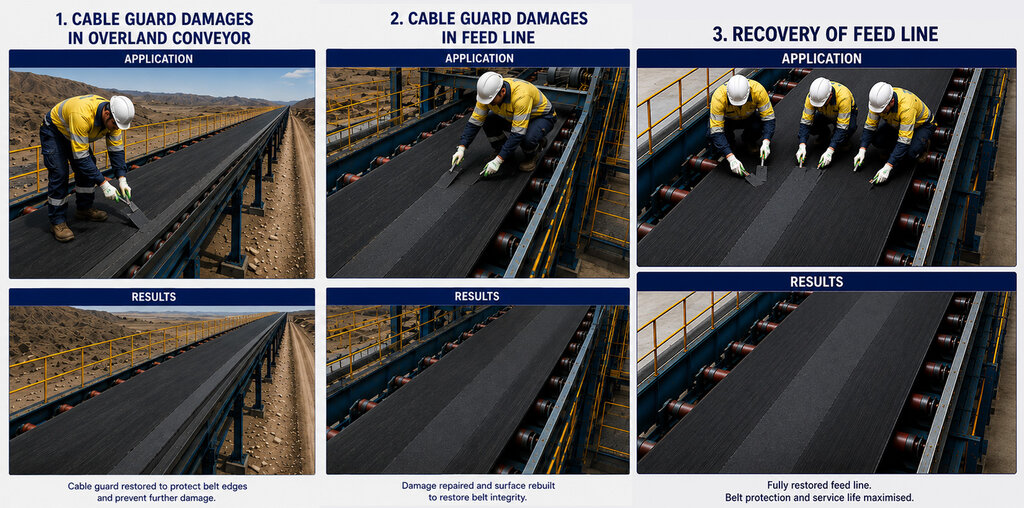
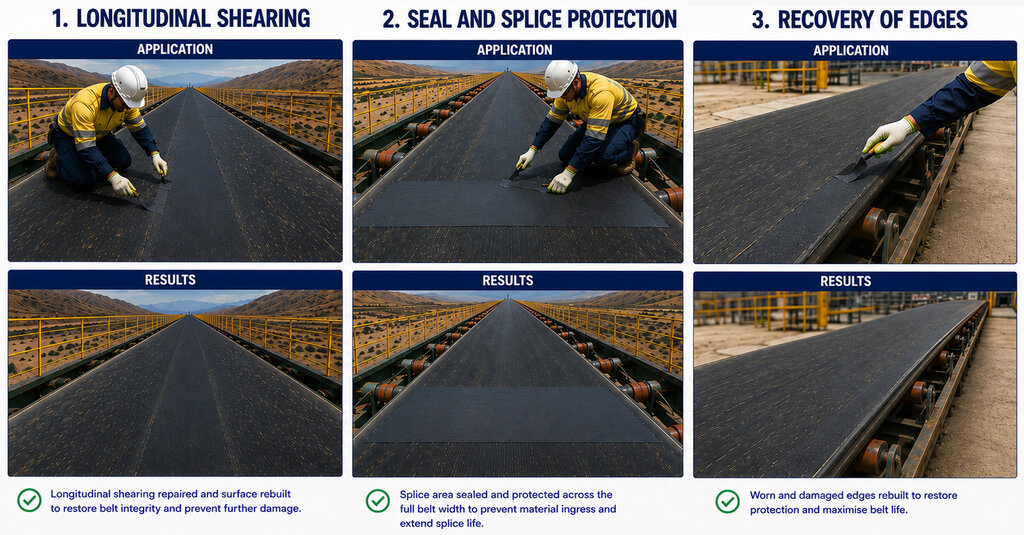
Normal applications Red Line.
The benchmark. Still running.
Nearly three decades after the first application, Red Line remains the solution maintenance engineers reach for when a conveyor belt needs to keep running — in the Atacama, in the Pilbara, in the copper belts of Central Africa and the nickel fields of Southeast Asia.
For Australia's Tier 1, 2 and 3 mining operations, Red Line is more than a repair compound. It is a proven philosophy: that the right material, applied the right way, by the right team, can keep an operation running strong and steady — whatever the belt, whatever the conditions, whatever the shift.
To learn more about the Fourthane Red Line family and its applications for Australian mine sites, visit fourthane.com
Contact information
Fourthane Australia
Suite 426, Level 2
75 Surf Parade
Broadbeach QLD 4218, Australia
Email: fourthane@fourthane.com
Web: www.fourthane.com