Company Insight
Sponsored by SES
Your Satellite connectivity might be falling short —here’s why
Modern mining relies on systems that demand constant, high‑performance connectivity to remote sites, yet many satellite solutions struggle to keep pace.
Main image: Elements of the SES multi-orbit network.
With better alignment between space connectivity and evolving operational needs, companies can unlock the full potential of their technology investments and avoid roadblocks on the path to digital transformation.
As with most modern enterprises, mining operations have become increasingly digital. Autonomous haulage, remote operations centers, predictive maintenance, and advanced analytics are now key to how modern mines operate. These systems are central to productivity, safety, and decision-making.
And like other enterprises, mining depends on continuous connectivity to keep their systems functioning. Due to the location of mine operations, these connectivity needs often extend beyond the reach of terrestrial networks. Space connectivity is a standard part of the technology mix for remote sites, and the adoption of satellite has grown particularly as newer services have made it easier than ever to deploy.
At the same time, many mining operations are seeing satellite connectivity fall short of what their applications and digital systems require, impacting both short- and long-term projects. A recent survey of mine operators showed that 83% of mining companies have delayed or cancelled technology investments due to connectivity limitations.
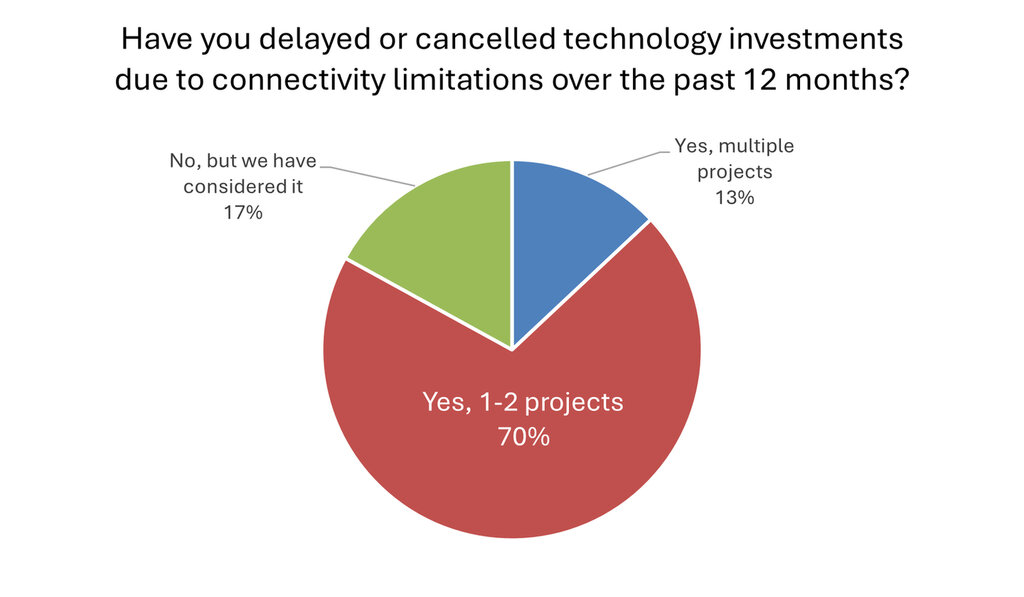
Source - Harbour and SES Mining Connectivity Report, 2025.
Rather than a weakness of satellite connectivity in general, the issue is often more associated with the alignment (or misalignment) of the connectivity with the requirements of mining applications and the operational objectives they are meant to support.
Why satellite connectivity doesn’t always deliver in practice
Satellite connectivity is being adopted more widely today as services have become easier to order and deploy. This has made it an attractive option for connecting remote environments and quickly adding bandwidth to support digital initiatives.
However, while fast deployment may provide quick initial relief for fast-moving IT and OT priorities, it does not necessarily translate into a level of performance required for sustained operational use. In the long term, success will depend on how consistently mining connectivity solutions support applications over time.
The impact of “good enough”
Consider the impact of “good enough” connectivity on these high-level expectations:
- Keeping operations running consistently. Many systems depend on stable and predictable connectivity to function effectively. Variability in latency or performance can disrupt workflows and affect production efficiency.
- Moving data where it needs to go. Modern mines generate significant volumes of data that must be transferred off-site for monitoring, optimization, and analysis. When connectivity cannot sustain that cloud-bound (upload) flow consistently, visibility is reduced and decisions are delayed.
- Maintaining visibility and safety across the site. Safety systems rely on continuous connectivity across fixed and mobile environments. Gaps in coverage can create blind spots that increase operational risk.
Connectivity that cannot reliably support these requirements will ultimately limit how well digital systems run and how effectively mines operate.
Versatility to address always-changing operations
Furthermore, mining operations don’t stand still. As mining activities evolve from exploration through production and expansion, application needs and their connectivity requirements change. At the same time, operations must support a mix of fixed sites, mobile equipment, and temporary deployments.
This creates a range of demands that exist simultaneously. Fixed production systems require stability and consistent performance. Mobile assets require flexible connectivity that can move with operations. Exploration and transitional activities require solutions that can be deployed quickly and adapted as conditions change.
Understanding how these different needs intersect is key to ensuring that connectivity supports an entire operation, rather than addressing subsets of siloed requirements.
Aligning satellite solutions with long-term operational expectations
This points to the importance of aligning connectivity characteristics with the specific needs of operational systems. “Satellite” is not a single, uniform service or capability. Space solutions will be applied effectively when their different performance characteristics are matched to the right use cases.
For example, SES leverages a multi-orbit portfolio that capitalizes on the distinct strengths of different satellite constellations. Geostationary orbit (GEO) services offer wide-area coverage and efficient distribution. Low-Earth orbit (LEO) systems can support latency-sensitive applications where needed. SES MEO, the only widely available commercial MEO (medium-Earth orbit) service, combines the industry’s highest upload throughputs with low latency and consistent, predictable performance.
In addition to the versatility of a multi-orbit portfolio, SES solutions span from long-term fixed deployments to land-mobile solutions that deliver coverage to vehicles and moving personnel. This allows connectivity to be applied more deliberately across fixed, mobile, and evolving operational contexts.
Satellite connectivity delivers real value in mining when it is aligned to how it needs to perform in operational use. For mining operations, selecting satellite solutions based on their ability to meet changing expectations and address competing operational priorities is the key to successfully integrating the benefits of space to meet real-world network demands.
About SES
SES is a global space solutions company empowering businesses and governments with purpose-built satellite and connectivity solutions.