Company Insight
Sponsored by Acquire
Geological data management starts with QA/QC
Beyond compliance: How streamlined QA/QC builds confidence in geological data.
Main image credit:
In many operations, quality assurance and quality control (QA/QC) are still managed separately from the core geological database, often in spreadsheets, and reviewed after the fact. Acquire's Geoscientific Information Management (GIM) Solutions take a different approach, running automated QA/QC checks as part of the data management workflow. Keeping those checks and their results in one connected environment helps geologists catch problems earlier and keep data consistent across the project.
Steve Jeffrey, Product Owner at Acquire, explains why modern mining needs a more integrated approach to data quality, and why the real gain comes from rethinking where QA/QC sits in the workflow, not just digitising existing processes.
Why does QA/QC matter so much in mining, and how has its role evolved as technology has advanced?
Steve Jeffrey: Resource confidence starts with QA/QC. It's what stands between a raw sample and a number a company is willing to put in front of investors, regulators, and the market. For a long time that confidence was built by hand: paper logs, spreadsheet reconciliations, a geologist remembering which lab batch looked "off." As deposits get more complex and reporting standards get tighter, that approach doesn't hold up. There's too much room for error to slip through unnoticed.
The real change is where QA/QC sits in the process. It used to be a checkbox at the end. Now standards, blanks, and duplicates get tracked automatically, and the statistical checks happen at the point of import rather than weeks later during a resource audit. You're not catching the error after it mattered anymore. You're catching it before it reaches the resource model.
What are the most common QA/QC failure points you see in mining operations today?
Steve Jeffrey: Most of it isn't unusual. Sample mix-ups, mislabelled standards, standards and duplicates inserted at inconsistent rates, batches accepted without anyone checking the control charts. I've seen a duplicate come back 15 to 20% off the primary value and sit there for weeks, because nobody was looking at the right chart at the right time.
Underneath most of that is fragmentation: a lab on one platform, exploration running its own spreadsheet, nobody with a single source of truth for what standard material went where. There's a timing problem too. Even when data is collected properly, if it's only reviewed periodically, an issue can go undetected for weeks, by which point the affected samples are already in a model or a report. It's the combination of fragmentation and lag that does the real damage, rarely one big mistake. Fix the fragmentation and shorten the lag, stopping problems before they start.
How is the volume of geoscientific data and complexity changing the QA/QC challenge?
Steve Jeffrey: There's more of everything than there was five years ago: more holes, more elements per assay, and more frequent sampling. That's good for geological understanding, but it multiplies the QA/QC workload fast. A review process that worked fine for a few hundred samples a month falls over completely once you're running a modern multi-rig drilling campaign. That's where automation pays for itself. Apply consistent statistical thresholds across thousands of records, surface only the exceptions that need a person's judgement, and QA/QC keeps working even as the program scales up. Skip that step and teams either drown in review work or start cutting corners to keep pace, and cutting corners is riskier out of the two.
What role does standardisation play in getting QA/QC right?
Steve Jeffrey: Naming and units cause more trouble than people expect. Different labs reporting in different units, standards tracked under different codes at different sites, project teams that all do things slightly differently. These small differences create friction and that friction makes it hard to build confidence in the numbers company wide.
Good geoscientific data software handles that without turning every geologist into a compliance officer. It gives teams a consistent structure for inserting and labelling QA/QC samples, and keeps that structure the same across every site and every lab relationship. That's what allows control charts and statistical rules to mean the same thing whether you're looking at one project or an entire portfolio.
Caption. Credit:
How has reviewing QA/QC at the point of import changed the way teams respond to issues?
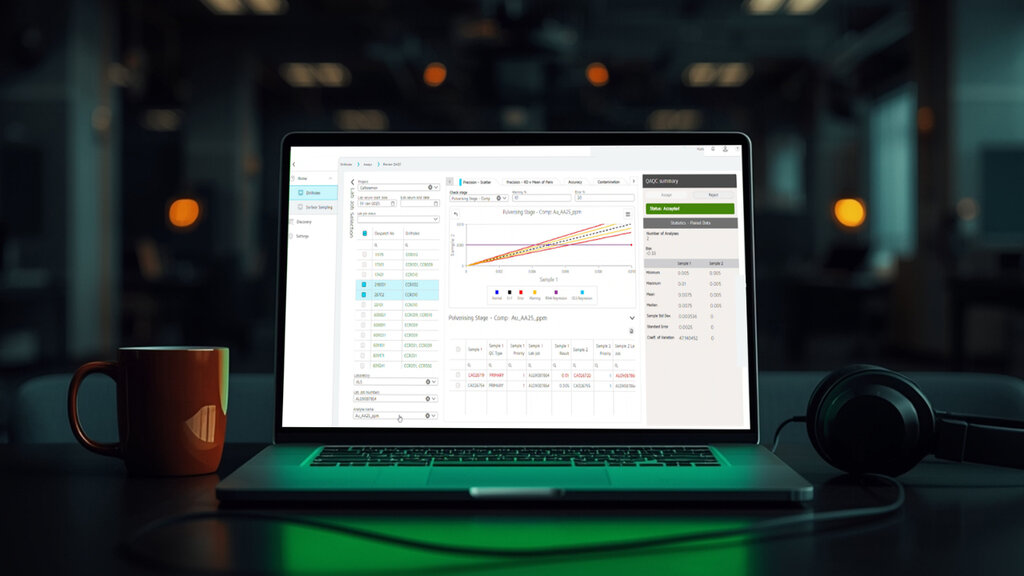
Steve Jeffrey: This is probably the biggest practical change, even though it's not a flashy one. Instead of waiting for a periodic review, a statistical and graphical check runs the moment a batch of results comes in, before it's available to users of a geological database. A failed standard or an out-of-tolerance duplicate shows up straight away, and the team decides then and there whether to accept or reject the data. This is something Acquire has built in as standard into both of its geoscientific information management solutions.
It changes behaviour too. When people know a problem will surface at the point of import rather than months later, they tend to be more careful upstream and downstream. There's no multi-week gap for a bad habit to hide in. Over time the feedback loop between field and lab gets shorter, and QA/QC starts feeling like part of the daily workflow instead of an audit that happens to you.
What should mining companies look for when evaluating QA/QC capabilities within geological data management software?
Steve Jeffrey: Fit comes first for me. Does it match how geologists and lab techs already work, or is it asking them to change everything at once? Software that fights daily habits struggles to get adopted, no matter how good its statistics are. After that, look for real automation in the control charting and threshold-based alerting, rather than a digitised version of the same paper process.
Integration matters just as much. QA/QC needs to talk to sample management, assay data, and resource modelling, ideally in one connected environment instead of manual exports and re-imports. And auditability: can the software show exactly what quality control a result passed through and how it was validated? That's only getting more important as reporting standards and investor scrutiny tighten up.
Looking ahead, where do you see QA/QC in mining software heading over the next few years?
Steve Jeffrey: I think the whole industry, not just us, will end up moving toward more predictive QA/QC. Right now, the trigger is usually a standard that's already failed. The real value is spotting patterns before they become problems, whether that's a gradual drift in a particular element or duplicate results from a lab becoming less consistent over several months, all before anything crosses a hard threshold. That's an early-warning system rather than a pass/fail gate, though it's fair to say the industry is still working toward it rather than there yet.
The other thing I'd expect is QA/QC folding into the rest of the geological data pipeline rather than sitting off to the side. Quality becomes a property of the data itself as it moves from field to lab to model, not a separate step tacked on at the end. Companies that get there first will spend a lot less time reconciling and a lot more time interpreting what they've got.
How does Acquire’s GIM Solutions fit into this picture, and what should users be looking forward to?
Steve Jeffrey: This is the direction we've been building our GIM Solutions toward for a while. The upcoming GIM Suite 5.7 release brings standards, blanks, and duplicate tracking into the web environment where teams already manage their sample and assay data, with control charting and threshold-based warnings built in. It's a direct answer to the fragmentation problem we talked about earlier: one connected system instead of a patchwork of spreadsheets and lab exports.
GIM Essentials is the simpler option for teams that don't need a full enterprise rollout, a good fit for smaller programs in resource development stages or companies just getting their QA/QC process formalised.
Between the two, that's where we think the industry needs to land: QA/QC that's continuous and automated, built into the everyday workflow rather than bolted on at the end.
Build confidence in your geological data
QA/QC should be more than a compliance exercise. It should be a continuous process that improves data quality, reduces risk, and gives teams confidence in every decision built on that data.
Explore how Acquire’s Geoscientific Information Management (GIM) Solutions help mining and exploration teams standardise QA/QC, automate validation, and maintain a trusted source for geological data management.
Visit Acquire's Geoscientific Information Management Solutions
Visit Acquire at IMARC 2026, Booth B16, to learn how GIM Solutions create a single source of truth for geological data.
Contact information
Acquire Technology Solutions Pty Ltd
Level 4, The Atrium
168 St Georges Terrace, Perth
Western Australia 6000
Tel.: +61 8 9316 6600
Email: sales@acquire.com.au
Web: www.acquire.com.au