Company Insight
Sponsored by Dieci Australia
Heavy-duty handling: Inside Dieci’s Hercules telehandler range
Dieci’s Hercules 130.10, 190.10, 210.10 and 230.10 bring 13‑23‑tonne lifting capacity to demanding Australian worksites.
Main image credit:
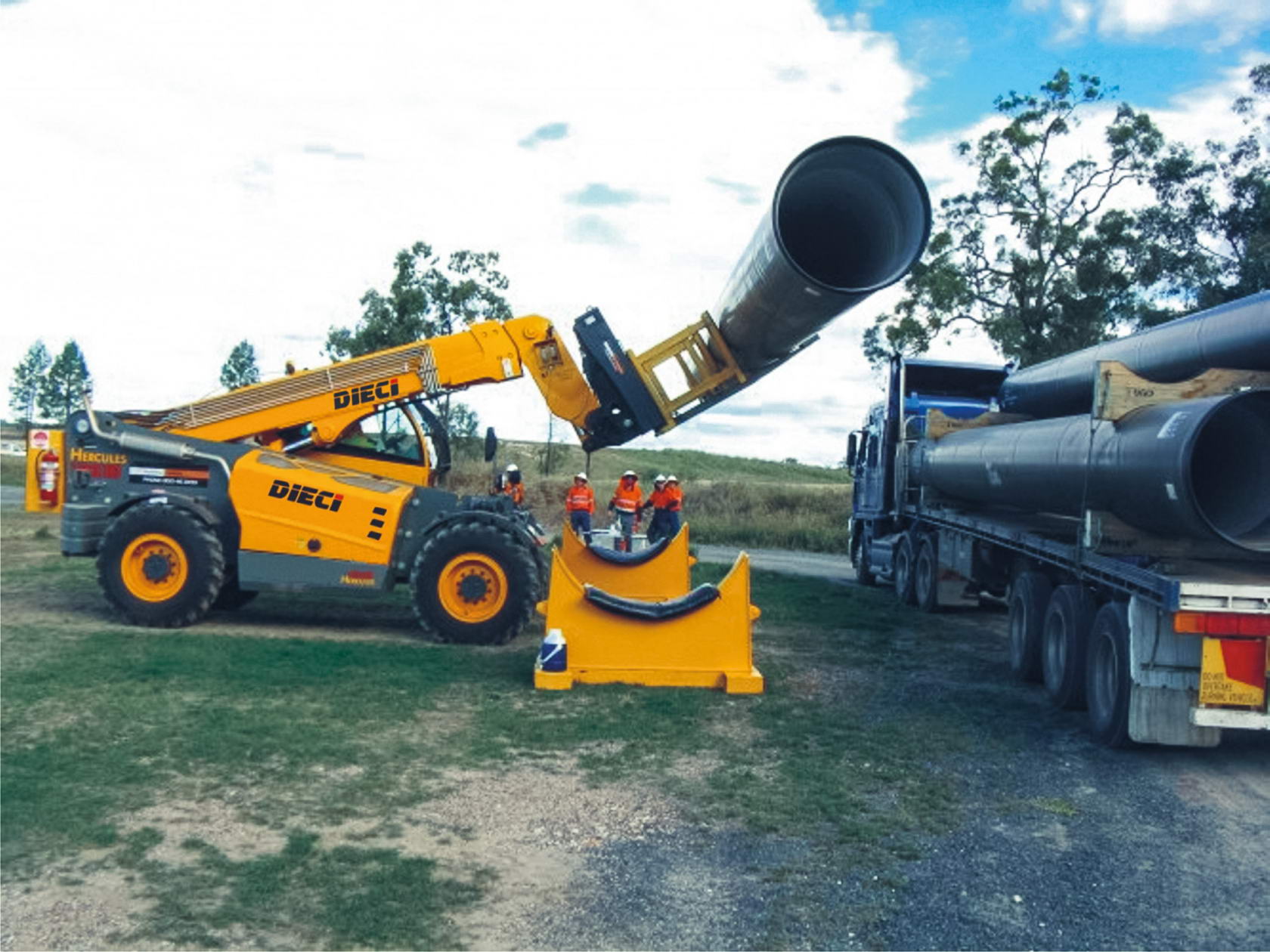
Moving large components around a mine site, an industrial facility or a major infrastructure project requires more than lifting capacity. Uneven terrain, restricted work areas, and the need to position heavy loads accurately can make stability, manoeuvrability, and machine control equally important.
Dieci Australia’s Hercules range has been developed to meet these challenges. The four models in focus, the Hercules 130.10, 190.10, 210.10 and 230.10, provide maximum lifting capacities from 13,000kg to 23,000kg, with lifting heights of up to 10.2m.
Across the range, Dieci combines heavy-duty construction with four-wheel drive, multiple steering modes, hydrostatic transmission and load-sensing hydraulics, providing a family of telehandlers designed to give operators the controlled movement of substantial loads while maintaining the mobility required across complex worksites.
Caption. Credit:
Telehandlers for heavy lifting and precise control
The Hercules 130.10 is the entry point to the four-model range, with a maximum capacity of 13,000kg and maximum lifting height of 9.5m. Its 125kW (168hp) FPT diesel engine is paired with a 160L/min hydraulic pump, and it offers an unladen weight of 18,000kg and maximum speed of 34km/h.
Moving up substantially in capacity, the Hercules 190.10 can lift up to 19,000kg with a reach of 10.2m. It is powered by a six-cylinder FPT diesel engine producing 129kW (173hp), with hydraulic flow increased to 170L/min and a maximum operating pressure of 35MPa. The Hercules 210.10 increases maximum capacity to 21,000kg while maintaining the 10.2m lifting height and 129kW power output of the 190.10. The unit’s unladen weight rises to 27,500kg, while pull-out force increases from 16,200daN on the 190.10 to 18,900daN.
At the top of the range, the Hercules 230.10 delivers a maximum capacity of 23,000kg. The unit shares the 10.2m lifting height, 129kW FPT engine and 170L/min hydraulic flow of the 190.10 and 210.10, but has an unladen weight of 29,000kg.
Model | Maximum capacity | Maximum lift height | Nominal power | Unladen weight |
Hercules 130.10 | 13,000kg | 9.5m | 125kW / 168hp | 18,000kg |
Hercules 190.10 | 19,000kg | 10.2m | 129kW / 173hp | 24,500kg |
Hercules 210.10 | 21,000kg | 10.2m | 129kW / 173hp | 27,500kg |
Hercules 230.10 | 23,000kg | 10.2m | 129kW / 173hp | 29,000kg |
Hercules machines use hydrostatic transmission with a variable‑displacement pump, combined with a servo‑controlled two‑speed gearbox.
Hercules machines use hydrostatic transmissions with a variable-displacement pump, combined with a servo-controlled two-speed gearbox. Three steering configurations, two-wheel steering, four-wheel steering and crab steering enable operators to adapt the machine’s movement to the available space and the task.
For operations requiring particularly fine control, the range is equipped with an inching pedal. This allows operators to slow forward movement substantially or stop while maintaining the engine speed required for hydraulic operations, supporting precise positioning during loading.
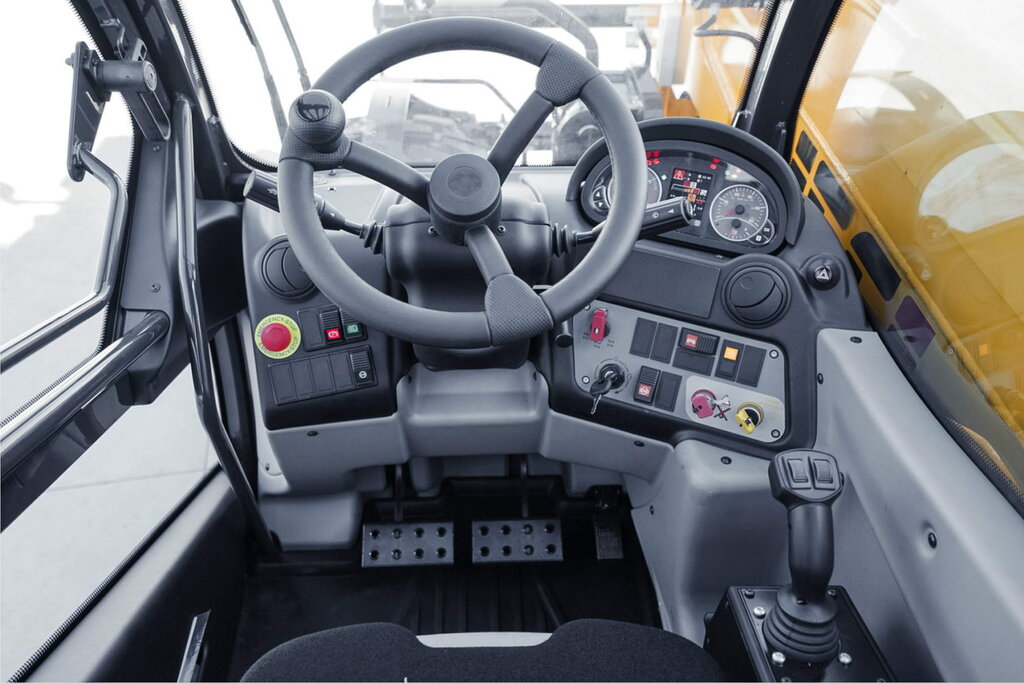
Boom functions are managed through a proportional 4-in-1 joystick with simultaneous controls. Dieci’s flow-sharing hydraulic system is designed to make boom movements predictable and proportional, which is vital when working with large loads close to equipment or fixed infrastructure.
Another feature is Dieci’s patented single compensation cylinder, positioned inside the lifting ram. This keeps the load balanced on the boom and supports component durability.
Safety on Australian worksites
The Hercules cab is ROPS-FOPS approved and features a safety cell around the operator. A deadman switch on the joystick works alongside an operator-presence sensor in the seat to help prevent unintended machine operation. The cab also incorporates soundproofing, an adjustable steering wheel, storage and an air-suspension seat. A heater and semi-automatic air-conditioning system provide climate control across varying operating conditions.
Dieci telehandlers comply with AS1418.19 / AS10896.1. The range is equipped with a Load Limiter Device that continuously assesses vehicle stability. This means that when predetermined safety limits are reached, the system inhibits movements that would further reduce stability.
Caption. Credit:
Attachments for multi-role operations
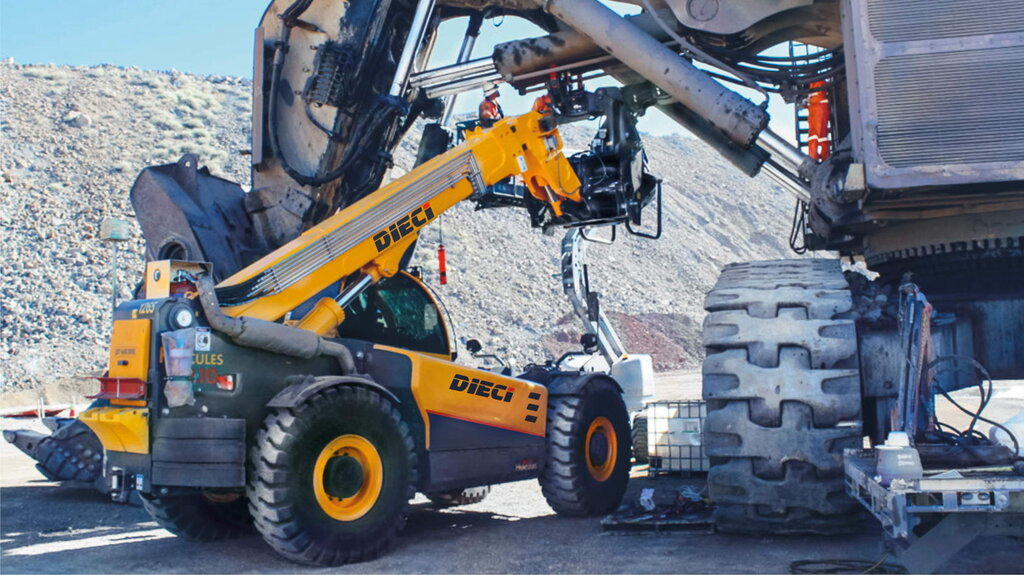
Dieci offers the Hercules range with attachments including forks, buckets, winches, hooks, jibs, elevated work platforms, cylinder grabs and tyre handlers. This selection enables the machine to support different materials-handling and maintenance requirements, rather than being restricted to a single lifting configuration.
The boom’s fork swivelling angle ranges from 113° on the Hercules 230.10 to 144° on the 130.10 model, providing an extended operating arc when working with the boom raised. Dieci provides attachment-specific load information, with alternative load charts available for different configurations.
Caption. Credit:
High-capacity telehandlers backed by Australian support
These four Hercules models provide operators with an industry-proven option at the heavy end of Dieci’s Australian telehandler range. The 130.10 provides 13-tonne capacity in the smallest package of the group, while the 190.10 and 210.10 accommodate increasingly heavy materials handling. The 230.10 extends maximum capacity to 23 tonnes, suitable for the most demanding applications.
Dieci Australia supports the heavy-duty range through its Australian branches and wider parts and service network, along with its three-year/3,000-hour warranty for these high-capacity telehandlers.
More information on the Dieci Hercules range
Contact information
Dieci Australia
Head Office
Unit 1, 5 Melito Court,
Prestons NSW 2170
Tel.: +61 1300 888 479
Email: sales@dieciaustralia.com.au
Web: www.dieciaustralia.com.au