
Feature
Autonomous mining’s next challenge: making the whole fleet work together
Autonomous haulage is evolving beyond driverless trucks to coordinated fleets. The next challenge is proving mine‑wide autonomy can operate reliably at commercial scale. Kris Cooper reports.

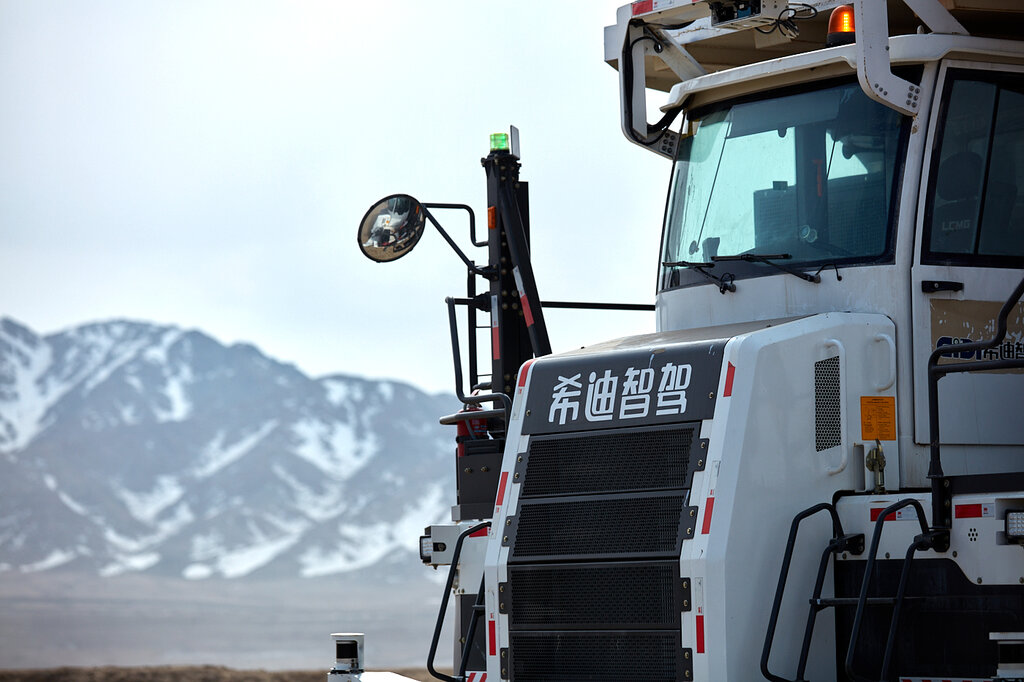
Main image: CiDi’s fleet of autonomous mining trucks at an operating mine in China. The company’s MetaMine architecture coordinates autonomous haulage, fleet dispatch and teleoperated excavation as part of a mine-wide operating system. Credit: CiDi
Automation and electrification are rippling through the mining vehicle industry, but the industry’s next challenge extends beyond deploying individual driverless trucks. Increasingly, miners are looking for intelligent systems capable of coordinating entire fleets to improve safety, productivity and energy efficiency.
According to GlobalData’s report Development of Electric Vehicles in Surface & Underground Mining, 2026, published in May, autonomous and autonomous-ready equipment now comprise more than 4% of all key mining machinery.
As autonomy starts to take up a noticeable share of mining equipment, machinery and technology providers are racing to deploy and showcase the degree of complexity they have achieved in their operations.
CiDi, a Chinese autonomous vehicle company listed on Hong Kong’s stock exchange, has been deploying steadily across China and is experiencing an increase in overseas deployments of its technology. Its MetaMine system integrates autonomous haul trucks with central dispatch and fleet coordination to support mine-wide autonomous operations.
Mixed autonomous operations
According to CiDi’s CEO, Albert Hu, the company’s China deployments are concentrated primarily in coal-cement mines and critical metals to a lesser degree.

Albert Hu, CEO of CiDi
Open-pit coal mining in particular is expanding rapidly in China, with some operations requiring fleets of hundreds of haul trucks. These large-scale mines have become the principal proving ground for CiDi’s MetaMine, which has already been deployed at 27 operating mines in China, while by the end of June 2026 CiDi says MetaMine had been deployed at nearly 40 mines worldwide.
In 2024, CiDi deployed a mixed autonomous operation at the CHN Energy Investment Group open-pit coal mine in north-west China. CiDi says that 56 autonomous trucks operated in mixed traffic with roughly 500 manned vehicles. In its August interim results, CiDi reported grown in revenue and deployments, with first-half 2026 revenue increasing 97% year-on-year. CiDi says seven locations were operating fleets of over 100 autonomous haulage trucks with the largest deployment being 220 units. By the end of June 2026, cumulative shipments of autonomous mining trucks had exceeded 1,900, according to the company.
Various sites around China are deploying a mixture of fully and partially automated solutions. Hu explains that out of their current offering the most popular is teleoperated excavation with autonomous haulage. The loading process depends on close coordination between teleoperated excavators and autonomous haul trucks, with real-time communication determining vehicle positioning and loading completion.

While autonomous haulage vehicles are the company’s foundation, [CiDi] also provides tools for autonomous excavating, drilling and blasting.
Frank Smith, Founder and CEO of TowHaul
While autonomous haulage vehicles are the company’s foundation, it also provides tools for autonomous excavating, drilling and blasting. In its interim results, the company says that its open-pit explosives-charging robot had rolled off the production line, while it plans to accelerate deployment of specialised robots for excavation, drilling and charging.
Speaking to MINE, Hu says the company’s next challenge is to export that experience. In April 2026, CiDi signed a memorandum of agreement with UK-based MMD Group, which acquired the intellectual property rights to the TraxIQ material-handling platform. The partnership is intended to combine CiDi’s autonomous haulage technology with MMD’s wider mine material-handling system. CiDi has identified Australia, Brazil and Indonesia as priority international markets, followed by Africa, Central Asia and the Middle East.
Operational complexity
Delving into the complexity of the operation, Hu explains how autonomy for the mining industry is a much more complex issue than the operation of driverless vehicles for road passengers. Due to the challenging terrain and ever-changing landscapes of mine sites, equipment requires precise and reliable of operating boundaries and obstacles. More critically, the degree of coordination of a whole fleet of equipment raises the stakes and standards for autonomous decision-making to accommodate these different scenarios.
Unlike passenger vehicles, autonomous mining equipment must optimise decisions across an entire fleet rather than for individual vehicles. “For an autonomous driving car you just have to have a good decision made individually,” says Hu, “but for mining you have to have a good decision for the whole fleet and you have to be transparent about what the fleet is going to do to make the operation more efficient.”
Decisions about queuing, overtaking broken machinery and paths all affect the fleet and operational efficiency of the entire mine, so an intelligent system must have a high standard of decision-making in order to keep things running smoothly.
MetaMine’s architecture has been developed to improve mine-wide productivity. Because every mine differs in terms of terrain, workflows and traffic patterns, the AI must learn each site’s operating environment and make decisions that optimise the movement of the entire fleet.
Unlike diesel trucks that can refuel quickly, battery‑electric haul trucks compete for limited charging capacity, making fleet scheduling part of the productivity challenge.
Frank Smith, Founder and CEO of TowHaul
Two issues often present in mines are traffic jams around the mine and charging of electrified vehicles. With roads often built too narrow, and huge numbers of vehicles maneuvering around the mine, traffic jams and bottlenecks can result in large decreases in efficiency.
Hu explains that central traffic planning – coordinating the best vehicle responses to obstacles and bottlenecks such as equipment breakdown – can help improve operational efficiency, overcoming delays that the decisions of human-operated vehicles may have been prone to.
Unlike diesel trucks that can refuel quickly, battery-electric haul trucks compete for limited charging capacity, making fleet scheduling part of the productivity challenge. Hu says that for operations with too little charging infrastructure, an off-cycle, staggered charging system is needed that can also take advantage of cheaper electricity prices.
Bringing together queueing issues with the need for charging can be a complicated problem, with hundreds of trucks needing to be factored into the equation – but this is the exact issue that data insights from the vehicles and an intelligent system can optimise in order to maximise efficiency.
The challenge becomes more complex as electrification is added to autonomous operations. At First Quantum Minerals' Kansanshi copper mine in Zambia, the company is testing a battery-electric haul truck under real operating conditions, using its existing Quantum Electra-Haul trolley-assist infrastructure. The trial is intended to generate practical data on productivity, reliability, charging, safety and maintenance rather than demonstrate autonomous haulage.
The trial illustrates how electrification could add another variable to fleet optimisation. FQM says its trolley-assist network already supports 128 trucks across its Kansanshi and Sentinel copper mines in Zambia, saving an estimated 45,000 tonnes of carbon dioxide equivalent (CO₂e) and 29 million litres of diesel in 2025. Gordon White, director of mining operations and technology at FQM, says “The most important lesson is that real-world deployment delivers insights that cannot be obtained through modelling and engineering studies alone.”
Safety and productivity
Reflecting on the Chinese mining industry, Hu highlights that, in China especially, safety is a key driver of the deployment of autonomous mining fleets.
The wider autonomous-vehicle sector has faced high-profile safety incidents and technical failures recently. In April 2026, more than 100 Baidu Apollo Go robotaxis reportedly stopped working following a system failure in Wuhan, disrupting traffic and leaving passengers stranded, although no injuries were reported.
“In China, there is a really strong push for safety,” Hu tells MINE. He goes on to explain that the government sets KPIs around driverless technology being implemented in mining, down to the penetration rate by a certain year in a certain region.
Across the industry there has been a push to remove humans from working in hazardous and harsh mining environments to reduce the possibility of accidents and casualties. Through the predictability and visibility of autonomous vehicles, mining operators are able to track obstacles and record this as structured data, so they can track when anything deviates from regular patterns and work to reduce hazards.
Rohit Singh, a GlobalData analyst, says that automated inspection and environmental risk detection, self-cleaning automation and remote control enhancements are other elements being developed to improve the safety of operating mines. He says that if these autonomous systems are able to operate successfully, the results should reduce the risk of machinery malfunction and enable humans to remain removed from extreme and hazardous environments by operating machinery remotely.
Barriers to autonomy
While autonomous operations are progressing quickly, in trials and mixed operations there still remain some key challenges to overcome to implement the technology successfully. Here, experts from across the field help to unpack three significant challenges facing the industry more broadly.
CiDi is expanding its autonomous haulage technology beyond China through a partnership with MMD Group to support the international rollout of the TraxIQ platform. Credit: CiDi
Connectivity
“Satellite connectivity has always been part of the mining industry, because by definition, mining is done most often in remote areas,” explains Eric Verheylewegen, vice-president of Strategic Initiatives Enterprise and Land Mobile at high-speed satellite broadband service provider Viasat.
The functionality of switching between satellite and cellular means operators can now enjoy full connectivity in remote locations at a fraction of the cost.
Frank Smith, Founder and CEO of TowHaul

Eric Verheylewegen, VP strategic initiatives enterprise and land mobile at Viasat
Verheylewegen goes on to explain that non-terrestrial networks narrowband is now being made possible via cell phone chips that can switch from satellite to mobile. The functionality of switching between satellite and cellular means operators can now experience full connectivity in remote locations at a fraction of the cost.
From Viasat’s perspective, the core issue is that many mining operators remain unaware that recent advances have made satellite connectivity considerably more affordable.
Verheylewegen explains that for mining executives it is important to choose mission-critical technology and resilient, weatherproof frequencies such as L-band, which can withstand high heat, extreme cold, dust and weather.
Cybersecurity
“The most immediate strategic risk appears to be cybersecurity,” says GlobalData's Singh.
While autonomous operations are driving an increased reliance on connected digital systems, and therefore increasing multiple entry points for attackers, Singh also adds that mining is being viewed increasingly as critical infrastructure, increasing its likelihood of being targeted.
AI
Singh says that scaling AI-enabled systems remains a key challenge for the industry.
“AI adoption is moving from discovery and experimentation towards validation, scale-up, manufacturing and product integration. In autonomous mining, the same pattern applies – companies must move from pilots and controlled deployments to reliable, mine-wide implementation,” Singh says.
As CiDi’s Albert Hu notes, these systems require a high degree of sophistication. Ensuring that AI can make reliable decisions at mine scale remains one of the industry’s biggest challenges.
The future of autonomous mining
Looking to the future, GlobalData’s report also delved into patent activity to see what technology is currently in development and how it could affect the industry.
The report found that, at the patent-activity level, the fastest-growing applications in autonomous mining vehicles are the automatic control of earth-moving machines, surveying the worksite, automated digging and mine safety systems.
Singh, who authored the report, says that these innovations are being fuelled by the potential for increases in productivity and fuel efficiency, coupled with the maturity of enabling technologies such as ultra-wideband and long range wireless networks, which help in precision positioning and making obstacle avoidance reliable enough for heavy vehicles and equipment.
...the next phase will be proving that hundreds of interconnected machines can operate safely, reliably and economically across an entire mine.
Frank Smith, Founder and CEO of TowHaul
Caterpillar, Baidu and Equipmentshare are highlighted by GlobalData’s report as having strong activity in the patent area relating to AI/machine learning for fleet orchestration, neural task planning, terrain mapping, excavation optimisation and scalable fleet systems.
The technologies required for autonomous mining are advancing rapidly, from intelligent fleet orchestration to automated drilling and excavation. Yet the industry’s biggest challenge is no longer demonstrating that autonomous equipment can function in isolation; the next phase will be proving that hundreds of interconnected machines can operate safely, reliably and economically across an entire mine.
As companies such as CiDi prepare for international deployments and major original equipment manufacturers expand their autonomous portfolios, the competitive advantage may increasingly lie not in building the smartest truck but in building the smartest fleet.
